The Differences Between IPv4 and IPv6: Why the Transition Matters
Introduction
Every single device connected to the internet—whether it is a massive enterprise server, your personal smartphone, or a smart thermostat—requires a unique identifier to send and receive data. This identifier is known as an IP (Internet Protocol) address. For decades, the digital world has relied on a system called IPv4 to provide these addresses.
However, as the internet has exploded in size, a fundamental problem has emerged: we have simply run out of IPv4 addresses. Enter IPv6, the next-generation protocol designed to support the future of global connectivity. While the transition has been gradual, understanding the technical differences between these two protocols is crucial for network administrators, IT professionals, and any business managing digital infrastructure today.
What is IPv4?
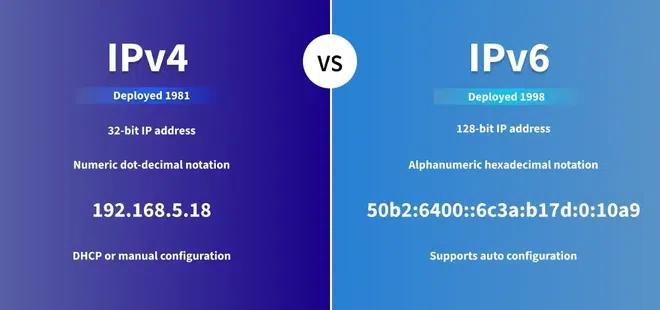
Deployed in the early 1980s, Internet Protocol version 4 (IPv4) is the foundational technology of the internet.
- The Structure: IPv4 uses a 32-bit address format. You are likely familiar with how this looks; it is typically displayed as four sets of numbers separated by periods (e.g.,
192.168.1.1). - The Limitation: Because it is a 32-bit system, IPv4 can only generate mathematically around 4.3 billion unique addresses. When the protocol was created, 4.3 billion seemed like an impossibly large, inexhaustible number. Today, with billions of people owning multiple internet-connected devices, that pool has been depleted.
To cope with this shortage, network engineers rely heavily on Network Address Translation (NAT), a clever workaround that allows multiple devices on a local private network to share a single public IPv4 address.
What is IPv6?
Internet Protocol version 6 (IPv6) is the evolutionary successor to IPv4, designed specifically to solve the address exhaustion problem while simultaneously upgrading how data is routed across the web.
- The Structure: IPv6 uses a massive 128-bit address format. Instead of just numbers, it uses a hexadecimal system (combining numbers and letters) separated by colons (e.g.,
2001:0db8:85a3:0000:0000:8a2e:0370:7334). - The Scale: The shift from 32-bit to 128-bit means IPv6 can provide approximately 340 undecillion unique addresses (3.4×1038). To put that into perspective, that is enough IP addresses to assign a unique identifier to every single atom on the surface of the Earth.
Key Technical Differences
Beyond just having a larger pool of numbers, IPv6 introduces several significant technical improvements over the older protocol:
1. Built-in Security (IPsec) In the IPv4 framework, security protocols like IPsec (Internet Protocol Security) are optional and must be manually configured by network administrators to encrypt data. In IPv6, IPsec is baked directly into the core architecture. This means end-to-end encryption and secure data packet routing are native features, drastically improving the baseline security of network traffic.
2. More Efficient Routing IPv4 packet headers (the meta-data attached to the data you send) are complex and variable in length, forcing routers to do extra processing. IPv6 uses a simplified, fixed-length header. This allows routers to process and forward data packets much faster, leading to lower latency and more efficient overall network performance.
3. Elimination of NAT Because IPv6 provides an effectively infinite number of public addresses, the NAT workaround is no longer necessary. Every device can have its own unique public IP address. This restores the true “end-to-end” connectivity model of the internet, making applications like voice-over-IP (VoIP), peer-to-peer file sharing, and live gaming much smoother to implement and troubleshoot.
Why the Transition Matters in 2026
The shift from IPv4 to IPv6 is not just an arbitrary software update; it is a critical infrastructure requirement for the modern web.
The primary driver is the Internet of Things (IoT). Today, manufacturing floors are filled with smart sensors, modern cars are essentially rolling computers, and homes are packed with connected appliances. All of these require IP addresses. Clinging to IPv4 and relying on complicated NAT configurations creates networking bottlenecks and limits scalability.
Furthermore, many mobile carriers and major Internet Service Providers (ISPs) have already fully migrated their core networks to IPv6. Businesses that fail to ensure their websites, servers, and digital services are IPv6-compatible risk degrading the user experience for a massive portion of global web traffic.
Conclusion
The internet has outgrown its original foundation. While IPv4 served the digital age well for over forty years, the sheer volume of connected devices demands a superior architecture. IPv6 provides not only the unlimited address space required for the next century of innovation but also the enhanced security and routing efficiency needed to keep global networks running smoothly. The transition is no longer on the horizon—it is already here.



Post Comment